Equal Playing Time in Youth Soccer: A Coach's Guide to Fair Rotation
One of the most common complaints in youth soccer is unequal playing time. Parents notice, players feel it, and coaches stress about it. Getting rotation right isn't just about fairness — it's about player development, team morale, and keeping families engaged with the program.
Why Equal Playing Time Matters
At the youth level (especially U8–U14), development should take priority over winning. Players who sit on the bench learn less, lose confidence, and are more likely to drop out of the sport entirely. Research from the Aspen Institute's Project Play shows that lack of playing time is one of the top reasons kids quit sports.
- +Every player improves faster with more game experience
- +Fair rotation builds trust between coaches, players, and parents
- +Balanced teams develop better depth and resilience
- +Many leagues and clubs mandate minimum playing time policies
Strategies for Fair Rotation
Achieving perfectly equal minutes every game isn't always realistic, but you can get close with a few practical approaches:
- 1.Pre-plan your rotation. Before the game, map out which players start and when substitutions happen. This removes in-game guesswork.
- 2.Use timed sub windows. Divide the half into equal segments (e.g., every 8 minutes in a 25-minute half) and rotate a group of players at each window.
- 3.Balance across games. If a player gets fewer minutes one game, start them the next. Track cumulative time over the season, not just per game.
- 4.Communicate your policy. Share your playing time approach with parents at the start of the season. Transparency prevents conflict.
Quick Reference: Fair Playing Time by Roster Size
Based on 25-minute halves (50-minute game). Use the calculator below for custom values.
| Format | Roster | Fair Time | Bench Time | Rotations |
|---|---|---|---|---|
| 7v7 | 10 | 35 min | 15 min | 3 waves |
| 9v9 | 13 | 34 min 37 sec | 15 min 23 sec | 3 waves |
| 11v11 | 14 | 39 min 17 sec | 10 min 43 sec | 4 waves |
| 11v11 | 16 | 34 min 23 sec | 15 min 38 sec | 3 waves |
| 11v11 | 18 | 30 min 33 sec | 19 min 27 sec | 2 waves |
Calculate Fair Playing Time for Your Team
Playing Time Calculator
Adjust the inputs to see how playing time breaks down for your team.
Results
Fair playing time
39 min 17 sec
Fair bench time
10 min 43 sec
Sub windows per half
4 waves
Rotate every
5:00
Sub Pattern
Pair your 13 outfield players into 5 groups of 3. Sub one group every 5:00. Each player plays ~19 min 39 sec and sits ~5 min 21 sec per half.
GK tip: Swap keepers at halftime — the 2 GKs get extra playing time
Per-half timeline
Position rotation tip
Want every player to experience different positions? Assign each group to a line (defense, midfield, attack) and rotate the assignments each game.
Want the app to handle rotations automatically during the game?
The Role of Technology
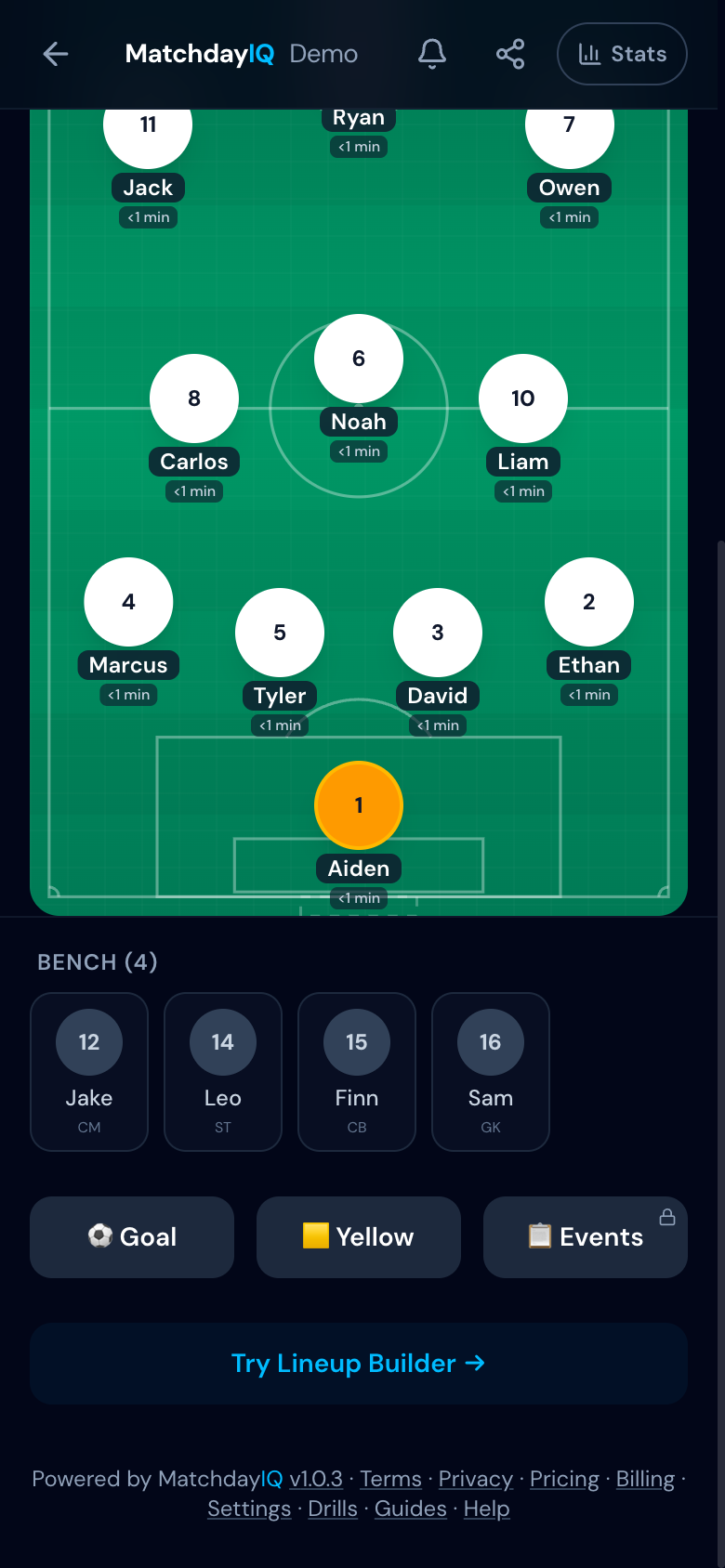
Tracking playing time manually — with a clipboard or memory — is unreliable, especially with a roster of 14+ players. A digital tracker records every substitution with exact timestamps and calculates minutes automatically. After the game, you can share reports with parents showing exactly how much time each player got.
How MatchdayIQ Helps
MatchdayIQ does this automatically — tracks every second, alerts you when someone has been sitting too long, and generates rotation plans before kickoff. The planner uses each player's preferred and secondary positions to make smarter substitution matches. For younger teams, the "Rotate Positions" toggle deliberately moves players through different positions each wave — great for development. Post-game, parents can see their child's minutes in the live spectator view — no awkward conversations needed.
Playing Time Guidelines by Age Group
Different age groups have different expectations and rules around equal playing time. Here's what to aim for:
U8–U10 (7v7)
At this age, equal playing time should be mandatory. Every child should play at least 50% of every game. Many leagues enforce minimum playing time rules. Focus on fun and development — winning is secondary. Rotate positions frequently so players learn multiple roles.
U11–U12 (9v9)
Fair playing time remains critical. Aim for every player to get at least 40-50% of game time. Begin introducing positional awareness, but still rotate. This is where many kids decide to stay in soccer or quit — equal opportunity keeps them engaged.
U13–U14 (11v11)
Playing time may become less equal as competitive levels diverge. However, recreational and house leagues should still target near-equal minutes. Travel and competitive teams may differentiate, but every rostered player should still get meaningful game time — not just 5 minutes at the end.
U15–U18 (11v11)
At the high school and older club level, playing time often becomes merit-based. However, coaches should still have a clear and communicated playing time policy. Players who attend every practice deserve game time. Many state high school associations have minimum playing time guidelines.
Common Rotation Mistakes Coaches Make
- ✗Only subbing at halftime — If you only substitute at the half, bench players sit for 25+ minutes straight. Use 2-3 sub windows per half instead.
- ✗Saving your "best" players for the end — This sends a clear message to other players that they're not valued. Rotate throughout the game, not just when the score is comfortable.
- ✗Tracking time in your head — You will forget. Use a digital tracker or at minimum a paper chart. MatchdayIQ tracks every second automatically so you never have to guess.
- ✗Not communicating the plan — Players and parents should know the rotation plan before the game starts. This reduces sideline anxiety and parent complaints.
Frequently Asked Questions
How do I calculate equal playing time for my team?▼
Divide total game minutes by roster size, then multiply by field size. For example, a 50-minute game with 14 players on an 11v11 team: each player should get approximately 39 minutes (50 × 11/14). Use our calculator above for exact numbers including sub windows.
Is equal playing time required in youth soccer?▼
Many recreational leagues and organizations mandate minimum playing time (often 50% per game). US Youth Soccer and many state associations have guidelines. Check your league rules — but even when not required, equal time is best practice for player development.
How do I handle playing time when one player is much weaker?▼
At the youth level, the weaker player needs MORE game time, not less — that's how they improve. Pair them with stronger teammates, put them in less pressure positions, and focus on small improvements each game.
What is a fair substitution rotation for 14 players in 11v11?▼
With 14 players in 11v11, you have 3 bench spots. Plan 3-4 substitution waves per half, rotating 3 players each time. Each player will get approximately 39 out of 50 minutes. Our rotation planner generates this automatically.
How do I track playing time during a game?▼
The best method is a digital app like MatchdayIQ that automatically timestamps every substitution and calculates minutes. The app also alerts you when a player has been on the bench too long and generates post-game reports showing exact playing time per player.
Should goalkeepers get equal playing time at forward?▼
At U8-U12, absolutely — rotate every player through every position including goalkeeper. At U13+, players may specialize, but even dedicated goalkeepers should occasionally play outfield in less competitive games.
Try it free — no sign-up needed
MatchdayIQ handles rotation plans, live tracking, and parent sharing so you can focus on coaching.